
2. Forms and validation
Chapter 1 left a project that greets you and reloads when you save. Reading a query parameter is one thing; accepting something a person typed is another, because a person can type nothing at all, or two hundred lines of it.
This chapter adds a form. The memos live in memory for now — chapter 3 moves them into a table — so the whole change is three files and about half an hour, with a stop halfway to look at what the first of them does before the other two exist.
0. Add Tailwind
Section titled “0. Add Tailwind”Chapter 1 declined Tailwind. Install it now:
pw add tailwindA wizard opens, and before anything is written it shows a review screen listing
every file it will create and every file it will append to. There is no flag
that skips it: this command edits a project that already exists. Accept it and
the pinned toolchain, assets/app.css, and the CSS build step go in.
This is what “declined at init is not permanent” means in practice. Chapter 3 adds the database the same way, and chapter 4 the login.
1. A page with a form on it
Section titled “1. A page with a form on it”The page has two jobs now: list what has been written, and offer a box to write
the next one. Replace handlers/home.pw.html:
package handlers
type Memo {  id: int  body: string}
export component Home(memos: Memo[]): html {  <h1 class="text-3xl font-bold">Memos</h1>  <form method="post" action="/memos" class="mt-6 space-y-2">    <textarea name="body" rows="3" required maxlength="200"      class="w-full rounded-lg border border-slate-300 p-3 focus:border-indigo-500 focus:outline-none"></textarea>    <button type="submit"      class="rounded-lg bg-indigo-600 px-4 py-2 font-medium text-white hover:bg-indigo-500">Add</button>  </form>  <ul class="mt-8 space-y-2">  {for memo in memos}    <li class="rounded-lg border border-slate-200 p-3">{memo.body}</li>  {/for}  </ul>}
type Memo declares a composite that becomes a Go struct, so the rows the
template renders and the rows the handler builds are one type rather than two
that have to be kept in step. Memo[] is a slice of it.
required and maxlength="200" are the form declaring what it will accept —
the same rules the check tag on createMemoInput will declare in a moment,
said to the browser as well. Press the button with the box empty, or paste more
than two hundred characters, and no request leaves.
That does not replace the validation on the server. The form is a convenience; the handler is the boundary. Writing both is not duplication: they stop different things, and section 5 is where the difference shows.
2. Make it compile, then look at it
Section titled “2. Make it compile, then look at it”Save the template and the build stops:
handlers/home_handler.go:21:37: unknown field Name in struct literal of type HomeParamsChapter 1 produced that error on purpose. This time it is incidental: the component takes memos now and nothing takes a name, so the handler is calling a function that no longer exists in that shape. Give it the argument it can supply today, which is none:
// handlers/home_handler.go — home, until section 3 gives it something to listfunc home(w http.ResponseWriter, r *http.Request) { pw.WriteHTML(w, r, Home(HomeParams{}))}Delete homeInput and the pw.Parse call with it. Nothing reads the query
string any more.
The page is now half a feature — a form that posts to a route that does not exist — and it is worth stopping here anyway, because two of the three things you just wrote can already be checked.
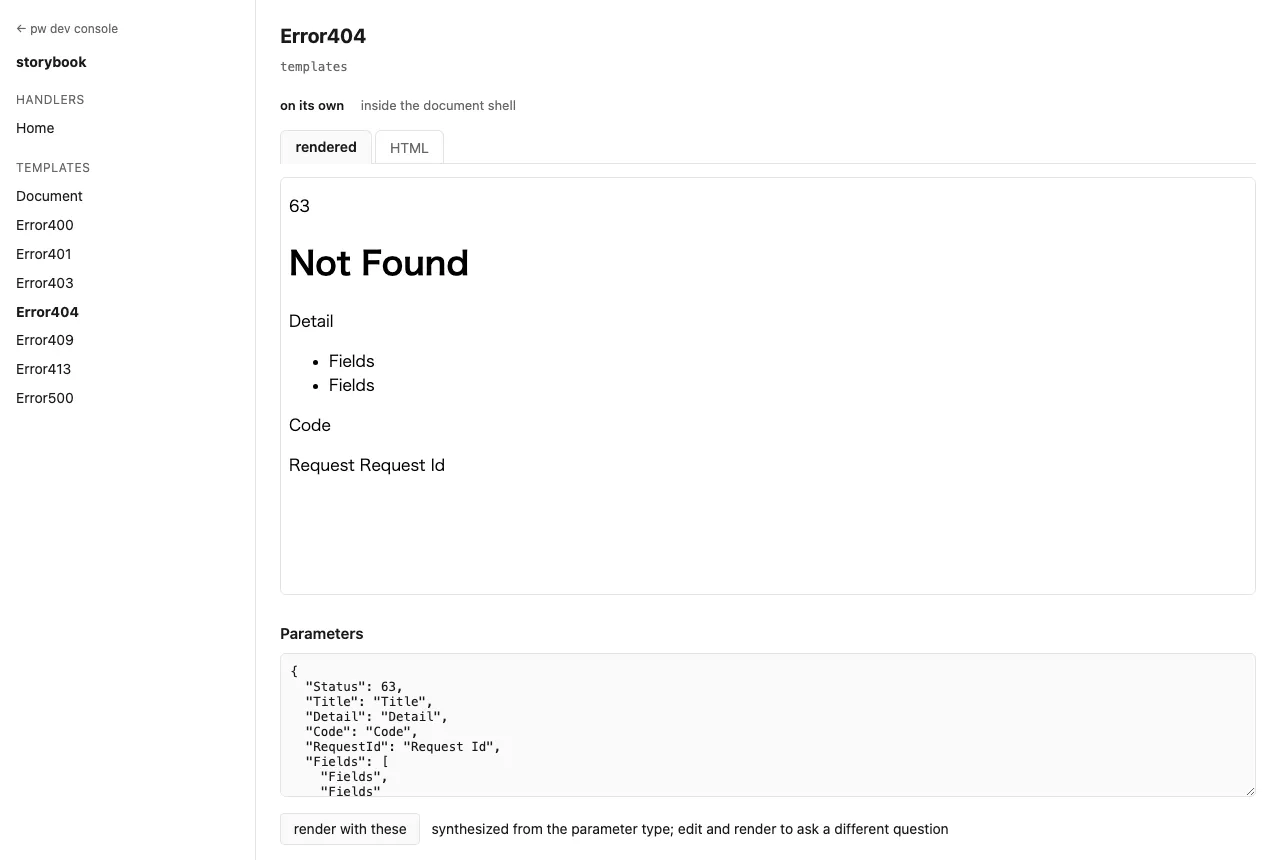
The template, on its own. Open the console at
http://127.0.0.1:18081, take the storybook pane, and select Home. It
renders with no application involved: two list items, both reading Body,
because the harness makes parameters up from their type and a string field is
worth its own name. Edit the parameters under the story and render again to ask
it a different question. That is the answer to “does this template do what I
think” without a handler, a route, or a row anywhere.
The page, in the browser. Reload http://localhost:8080/. The form is there and the list below it is empty, which is what an empty slice renders as. Type something and press Add:
404 page not foundNothing is broken. POST /memos is a route no one has registered, so the mux
has nothing to match and says so. Section 4 registers it.
3. Somewhere to put them
Section titled “3. Somewhere to put them”Memos need to survive from one request to the next. A slice behind a mutex is enough for one chapter:
package handlers
import "sync"
// memos keeps the list in memory. Chapter 3 replaces it with a table.var memos = &store{}
type store struct {  mu     sync.Mutex  nextID int  items  []Memo}
func (s *store) list() []Memo {  s.mu.Lock()  defer s.mu.Unlock()  return append([]Memo(nil), s.items...)}
func (s *store) add(body string) {  s.mu.Lock()  defer s.mu.Unlock()  s.nextID++  s.items = append([]Memo{{Id: s.nextID, Body: body}}, s.items...)}
Memo here is the type the template declared. Nothing converts between a
presentation type and a storage type, because at this size there is only one
type. Chapter 3 introduces the second one, and the conversion that goes with it.
4. Two routes
Section titled “4. Two routes”package handlers
import ( "net/http"
"github.com/shibukawa/popcornweb/pw")
func init() { mux.HandleFunc("GET /{$}", home) mux.HandleFunc("POST /memos", createMemo) // new}
// homeInput and its pw.Parse call went in section 2: nothing on this page// reads the query string any more.
// home lists every memo that has been written.//// changed: the empty HomeParams of section 2 now carries the store's list.func home(w http.ResponseWriter, r *http.Request) { pw.WriteHTML(w, r, Home(HomeParams{Memos: memos.list()}))}
// Everything below is new; none of it was in the scaffold.
// createMemoInput is the submitted form.type createMemoInput struct { // Body is the memo text. It is required and capped at 200 characters. Body string `payload:"body" check:"required,maxlen=200"`}
// createMemo stores one memo and redirects back to the list.//// A rejected submission comes back as the same page with the message beside// the field, not as a problem document.func createMemo(w http.ResponseWriter, r *http.Request) { input, err := pw.Parse[createMemoInput](r) if err != nil { pw.WriteProblem(w, r, err) return } memos.add(input.Body) http.Redirect(w, r, "/", http.StatusSeeOther)}GET /{$} is the scaffolded pattern, unchanged. A bare GET / in Go’s mux
matches every path that nothing more specific claims; the {$} restricts it to
the root, so a typo in the URL gets a 404 rather than the memo list.
payload:"body" reads the request body rather than the query string; the form
posts application/x-www-form-urlencoded, and the same declaration would accept
a JSON body from an API client without a second code path. The check rules are
compiled during generation, so required and maxlen=200 cost no reflection at
request time. Handlers lists every rule.
The redirect is a 303 See Other, and it matters more than it looks. A POST
that answers with a page leaves the browser holding a resubmittable request:
reload, and the memo is added twice. Answering with a redirect to GET / means
the reload re-reads the list instead.
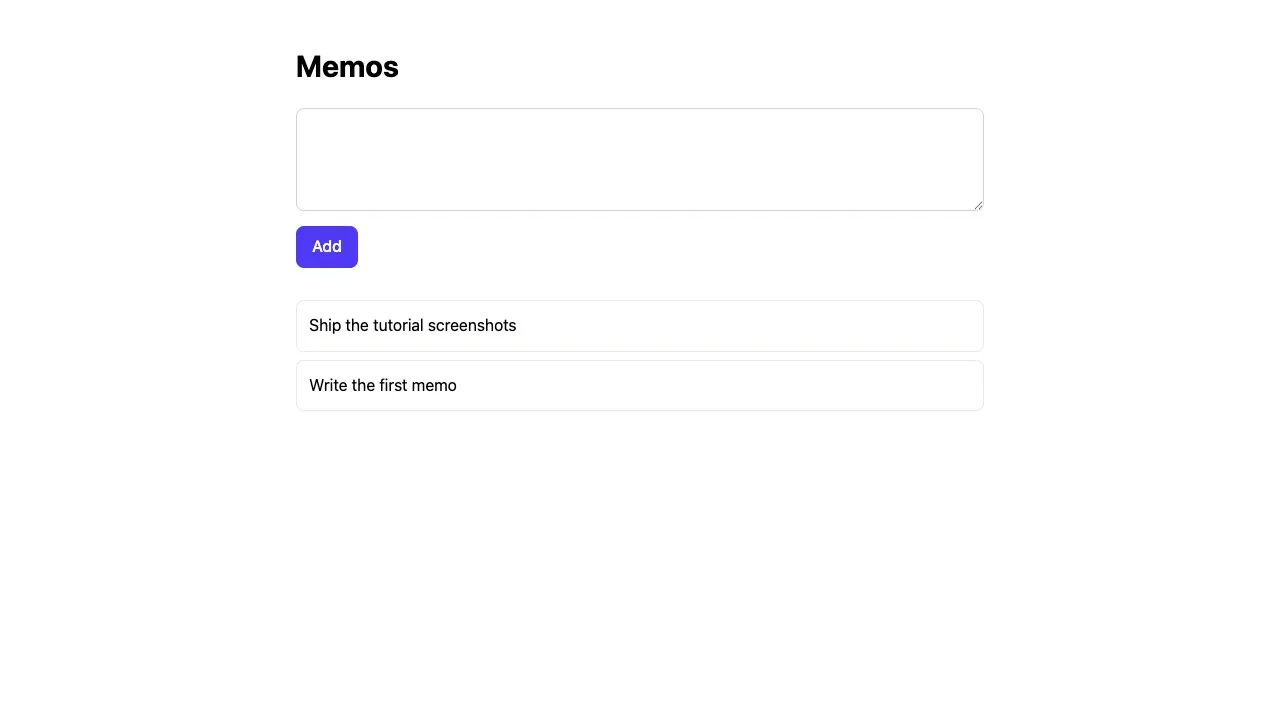
Save the files. pw dev regenerates, rebuilds, and restarts; type something
into the box and press Add. The 404 is gone, the browser follows the
redirect back to /, and the memo is at the top of the list. Add a second one
and reload the page: both survive, because they are in a process that has not
restarted. Save any file to make it restart, and they are gone — which is
chapter 3’s whole subject.
5. When it is rejected
Section titled “5. When it is rejected”Press Add with the box empty. Nothing happens. The browser refuses to
submit and puts its own message under the box, because the textarea says
required. Paste more than two hundred characters and it stops accepting them
at the two hundredth.
That is not the end of it. What the form stops is submissions from the form. Reach the same route without a browser:
curl -i -X POST http://localhost:8080/memos \ -H 'Content-Type: application/x-www-form-urlencoded' \ --data 'body='{ "code": "validation_failed", "detail": "Validation failed", "errors": [{ "field": "body", "location": "payload", "message": "required" }], "status": 400, "title": "Validation failed", "type": "about:blank"}That is check:"required" doing its half: RFC 9457 problem details, status 400,
the offending field named. Delete required from the form and this answer does
not change. Neither one was redundant — they stop different things. The form
catches a person mistyping; check looks at the request.
Now do it again as a browser would:
curl -i -X POST http://localhost:8080/memos \ -H 'Accept: text/html' \ -H 'Content-Type: application/x-www-form-urlencoded' \ --data 'body='HTTP/1.1 400 Bad RequestContent-Type: text/html; charset=utf-8Vary: AcceptThe same failure, answered as a page. pw.WriteProblem reads Accept and picks
the representation: templates/400.pw.html for a client that wants a page,
problem details for everything else. Notice that the handler has no branch in
it. One route answers a browser and an API client, and none of the code that
does it is yours.
That page is templates/400.pw.html, which pw init left behind. Open it and
you will find it takes the status, the title, the detail, and the field failures
as parameters. What fills them in is decided by the environment:
dev: everything the problem carries. The reader is the developer who caused it and is about to fix it.- anywhere else: the status, the title, and the request id. The same page served to the public says what went wrong and not why.
One template, and what changes is what it is handed. Restart under APP_ENV=prod
and the same curl comes back with the details gone.
What you have now
Section titled “What you have now”- A form that posts, a route that accepts it, and a redirect that survives a reload.
- Validation in two places: the form stops a person mistyping, the
checkrules stop the request. - Two representations of one failure, chosen by the framework from
Accept, with no branch in the handler.
The list still disappears on every restart. Chapter 3 gives it a table.
- 3. Storing the memos — the next chapter.
- Handlers — every source tag and check rule.
- Responses — problem details, JSON, and fragments.